|
 |
| |
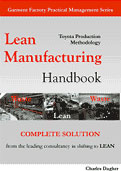 |
Complete Solution for the Apparel Manufacturing Industry
Item No.: LMB2220
Author: Charles Dagher
Pages:
Binding: Hardcover
Unit Price: USD 265.00
Shipping: Shipping fees & duty not included
|
|
|
|
| |
|
Unique handbook designed specifically for the garment industry guiding readers on the Lean journey. Explains how to identify waste related to materials and information flow; methodology in designing roadmap of processes and operations throughout the factory; step-by-step application of Lean principles and concepts with many innovative solutions for reduced costs, shortened lead time and improved quality. All elements and tools of Lean approach from Value Stream Mapping to Modular Manufacturing Cells are covered. Get in on all the consultancy secrets behind the Lean Manufacturing approach.
|
| |
 |
Value Stream Mapping
Item No.: MIF1100
Author: Charles Dagher
Pages:
Binding: Softcover
Unit Price: USD 50.00
Shipping: Shipping fees & duty not included |
| |
Designed specifically for the garment industry. Techniques behind effective mapping of operations from dock-to-dock. Explains how to illustrate Current State with problem-solving matrix to identify flow gaps and other waste, and introduces tools required to design desired Future State with Kaizen (continuous improvement) proposals. Defines Lean metrics. Methodology and forms included.
|
| |
 |
Item No.: WPO1250
Author: DCG Consultants
Pages:
Binding: Softcover
Unit Price: USD 44.00
Shipping: Shipping fees & duty not included |
| |
Learn the power of the 5S pillars, the foundation for workplace improvements, and effective tools for the elimination of waste in space, time, work practices and costs on the shop floor.
|
| |
 |
Item No.: VCS1200
Author: Charles Dagher
Pages:
Binding: Hardcover
Unit Price: USD 45.00
Shipping: Shipping fees & duty not included |
| |
Designed specifically for the garment industry. Assists in understanding how to apply the 10-step plan and how to define corporate objectives, needs and requirements in order to align the entire organization to common objectives through visual control systems. Unlike visual displays which relate information and data to employees in the area, a visual control actually controls or guides actions of affected group members. With effective visual control systems in place, it is possible to see at a glance just what is going on in the factory.
|
| |
 |
Item No.: TMM1150
Author: Charles Dagher
Pages:
Binding: Hardcover
Unit Price: USD 125.00
Shipping: Shipping fees & duty not included
|
| |
Effective transformation to modular manufacturing requires simulation. This book explains what simulation is, why it is necessary and how to carry it out, and is designed for use by engineers and managers. Past production problems are solved with improved team set-ups and formulation, leading to better use of space, labor and machinery. Grouping workers into U-shaped assembly cells achieves two important Lean objectives, namely One-Piece Flow and High Variety Production.
|
| |
 |
Item No. : TPM1150
Author: DCG Consultants
Pages:
Binding : Softcover
Unit Price: USD 78.00
Shipping: Shipping fees & duty not included |
| |
This book covers the eight activities for implementing TPM effectively as well as the four techniques of preventive breakdowns, corrective maintenance, preventive maintenance and breakdown maintenance. Also deals with Quick Changeover, whereby hours or even days of costly changeover time can be slashed.
|
| |
 |
Item No.: KSF1310
Author: Charles Dagher
Pages:
Binding: Softcover
Unit Price: USD 86.00
Shipping: Shipping fees & duty not included |
| |
This book covers tools and methodology for Kaizen (continuous improvement) events such as Flow and Point Kaizen to occur. Deals with how change occurs, how to achieve improvement and how to sustain it. Learn how to successfully conduct Kaizen events in 3-5 days.
|
| |
 |
Item No.: MMV1050
Author: Charles Dagher
Pages:
Binding : Softcover
Unit Price: USD 68.00
Shipping: Shipping fees & duty not included |
| |
Many factories complete a single order and then let goods sit in their warehouse occupying space until delivery. With flexible planning schedules based on real-time customer demand known as the Shishkebab Method, or Mixed Model production planning, several orders may be scheduled more or less simultaneously thereby avoiding the build-up of inventories. Production teams can change styles virtually at any time and revert back to the same style if needed with the minimum of downtime. This Lean technique ensures minimal waste in terms of overproduction, unnecessary space and underutilized labor and/or machinery.
|
|
|
|